About Delivery Methods
During delivery, we always exercise the utmost care and strive for early detection of abnormalities and prompt response.
When necessary, strict monitoring and medical intervention will be performed to ensure a safe delivery.
We also actively encourage “early skin-to-skin contact” between the mother and baby immediately after birth.
Even during this early contact period, all babies are monitored with oxygen monitors to confirm that there are no abnormalities.
If special medical care is anticipated, a pediatrician will attend the delivery and provide appropriate treatment immediately after birth.
Natural Delivery
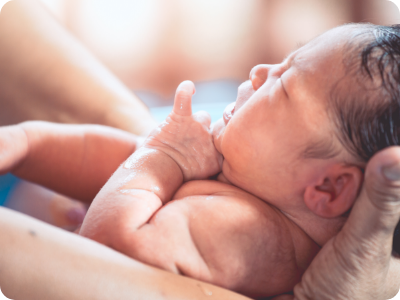
Natural delivery is a method in which the mother gives birth using her own strength after waiting for natural labor contractions to begin.
We value minimizing medical intervention and maximizing the natural abilities of both mother and baby.However, if it is determined that there is any risk to the mother or baby, necessary medical treatment will be provided with safety as the highest priority.
- Sophrology Childbirth Method
- The Sophrology childbirth method is a delivery method that combines breathing techniques and image training, with an emphasis on mental relaxation.
It encourages mothers to view labor pain positively as “the energy to meet the baby,” helping to ease anxiety and fear toward childbirth.
- Lamaze Method
- The Lamaze method is a type of “psychological painless childbirth method” in which mothers learn breathing and relaxation techniques to approach childbirth positively and relieve pain.
It aims to break the negative cycle in which fear of pain causes the body to tense up, making the pain feel even stronger, by using breathing and relaxation techniques.
In Japan, the “hee, hee, hoo” breathing method is especially well known.
Like the Sophrology childbirth method, it can be practiced regardless of location and is considered relatively easy to perform.
Painless Delivery
At our hospital, we offer “painless delivery (epidural anesthesia)” to help reduce anxiety and pain for expectant mothers and to support a more comfortable childbirth experience.
Painless delivery is not intended to completely eliminate labor pain, but rather to reduce pain while allowing labor and delivery to proceed safely.
About Painless Delivery
Cesarean Section
A cesarean section is a surgical delivery method in which the mother’s abdomen and uterus are incised in order to safely deliver the baby.
It is performed to protect the safety of both the mother and baby when vaginal delivery is determined to be difficult.
There are two types of cesarean sections: a “scheduled cesarean section,” in which the surgery date is decided in advance, and an “emergency cesarean section,” which is performed urgently during labor.
- Why Is a Cesarean Section Performed??
- When vaginal delivery is determined to be difficult, a cesarean section may be chosen for the following reasons in order to prioritize the safety of both the mother and baby.
Main Reasons for a “Scheduled Cesarean Section” Decided in Advance
- Breech Presentation: The baby’s head is positioned upward.
- Multiple Pregnancy: There is more than one baby, such as twins or triplets.
- Placenta Previa: The placenta is covering the opening of the uterus.
- Previous Cesarean Section: If a previous delivery was by cesarean section, a cesarean section may also be performed this time to avoid the risk of uterine rupture.
- Maternal Medical Conditions: The mother has an underlying condition such as heart disease or a brain disorder.
Main Reasons for an “Emergency Cesarean Section” During Labor
- The baby is not doing well: For example, if the baby’s heart rate weakens during labor and the baby is judged to be in poor condition.
- Labor is not progressing: Labor may stop for a prolonged period due to weak contractions or the cervix not opening sufficiently.
- Placental Abnormalities: Emergency care may be required, such as when the placenta separates before delivery.
A cesarean section is an important option to protect the lives of both the mother and baby.
Regarding the method of delivery, it is important to discuss your wishes and physical condition carefully and make a decision after you fully understand and feel comfortable with the plan.
If you have any concerns or questions, please feel free to consult your doctor or midwife at any time.
Information on Delivery Reservations
Patients who wish to give birth at our hospital are required to undergo prenatal checkups at our outpatient clinic in advance.
Appointments for prenatal checkups are accepted by telephone.
If you are currently receiving care at another medical institution, considering returning to your hometown for delivery, or have any questions, please feel free to contact us.
About Hospitalization
Transportation Service for Pregnant Women in Labor
This is a free service in which pregnant women who go into labor are picked up by an ambulance owned by our hospital.
※Please note that depending on vehicle availability and traffic conditions, the fastest possible arrival at the hospital may not always be possible.
Hospitalization Fees
| Natural Delivery |
JPY 500,000
※If you use the direct payment system for the childbirth and childcare lump-sum allowance, please prepare approximately JPY 20,000–80,000 on the day of discharge (or the previous day if discharge falls on a weekend or public holiday), depending on the length of hospitalization and treatment provided. |
| Cesarean Section |
JPY 500,000(when covered by health insurance) |
※If painless delivery is requested, an additional fee of JPY 130,000 or more will apply.
※ Private room charges are included in the hospitalization fee, so there are no additional out-of-pocket room charges.
About Visitation
ISEIKAI International General Hospital – Visitation Information
Visitation Hours(9:00~21:00)
- 14:00~16:00
- Visits in patient rooms(up to twice per day)
- 9:00~14:00/16:30~21:00(※Advance reservation required)
- Visits in the ward consultation room
- Babies will be placed in a cot for visits in the consultation room.
Eligible Visitors / Number of Visitors Allowed
- During Labor
-
- First Stage of Labor: Up to 3 people may enter (advance registration required)
- Second Stage of Labor: Up to 2 people may enter
- Attendance is permitted until 2 hours after delivery
- After Delivery
-
Reception Location
- Weekdays, weekends, and public holidays (14:00–16:30)
- South Building 3F – Patient Support Center Reception Counter (across from FamilyMart)
- Outside Regular Hours
- In front of the Security Office, South Building 1F
- During visitation hours, please make a reservation in advance using your smartphone.
- In consideration of visitation restrictions for general inpatients, once you enter the consultation room, we ask that you do not leave until your visit is completed.
Therefore, please use the restroom on the 1st or 3rd floor before coming to the ward.
Non-Invasive Prenatal Testing (NIPT)
Our hospital has been certified as a core facility for conducting NIPT starting from April 1, 2025.
What is NIPT?
NIPT (Non-Invasive Prenatal Testing) is a test used to assess the possibility of three chromosomal disorders in the fetus: Trisomy 21 (Down syndrome), Trisomy 18, and Trisomy 13.
The test can be performed from early pregnancy (around 10 weeks). A blood sample is taken from the mother to examine fetal-derived chromosomes contained in the blood.
This test estimates whether the fetus has numerical chromosomal abnormalities.
At our hospital, patients are required to undergo genetic counseling before proceeding with the test.
Contact Information
- Telephone Number:080-2400-8547
- Reception Hours: Weekdays(8:30~17:00)
- Department in Charge: Department of Genetic Medicine
Reservations
To make a reservation, a referral letter from your primary physician must be sent by fax.
- Items to Be Prepared by Your Primary Physician
- Information for Pregnant Women to Read
- For Pregnant Women Considering Non-Invasive Prenatal Testing (NIPT)(Japanese)
FAX:06-4301-5645
For More Detailed Information About the Department of Genetic Medicine
ISEIKAI International General Hospital – Department of Genetic Medicine (Japanese)
Delivery with a Birth Partner Present
At our hospital, we offer “delivery with a birth partner present” for patients who meet certain conditions.
Attendance is permitted only for full-term pregnancies from 37 weeks onward, and only one person may attend, either the husband (partner) or the patient’s mother.
Additional detailed precautions and information will be explained by our staff during the prenatal checkup around the 32nd week of pregnancy.
If you have any questions, please feel free to ask at that time.
Please note that depending on the spread of infectious diseases or other circumstances, partner-attended delivery may be suspended without prior notice.
Thank you for your understanding.
Returning to Your Hometown for Delivery
To ensure a safe delivery system, we manage and limit the number of delivery reservations.
Therefore, please note in advance that we may stop accepting delivery reservations once all available slots have been filled.
However, if emergency treatment is required depending on the condition of the mother or baby, we will respond on a case-by-case basis.
If you have any concerns, please consult us as early as possible.
Items Provided by Our Hospital
We provide all patients hospitalized for childbirth with a complimentary maternity set and hospitalization set containing hygiene items necessary for both mother and baby from delivery through the postpartum period.
Maternity Set
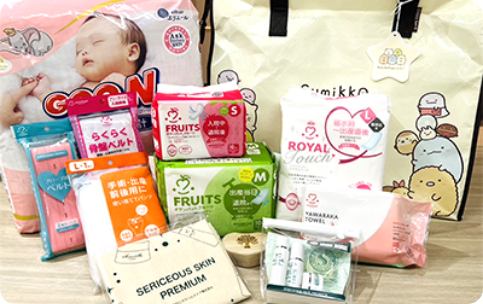
- Pads for Immediately After Delivery
- Postpartum Sanitary Pads (S: 10 pads, M: 10 pads, L: 5 pads)
- Disposable T-Pants
- One Pack of Baby Wipes
- NST Monitor Belt
- Umbilical Cord Box
- Pelvic Belt (Sarashi)
- Baby Diapers
Hospitalization Set
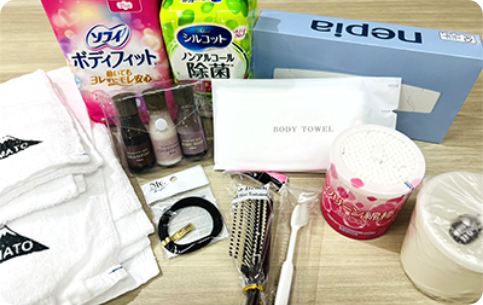
- Sanitary Pads (2 pads)
- Wet Wipes
- Tissues
- Body Towel
- Cup
- Cotton Swabs (3 pieces)
- Toothbrush Set (3 pieces)
- Comb
- Hair Ties
- Shampoo & Body Soap Set
- Towels and Bath Towels (from the day of admission for delivery to the day of delivery)
- Clothing for Delivery (from the day of admission for delivery to the day of delivery)
All items in the hospitalization set are provided as complimentary gifts until the day of discharge.